
Prayer Times Toronto: Your Complete, No‑Nonsense Guide to Accurate Salah Times in the GTA
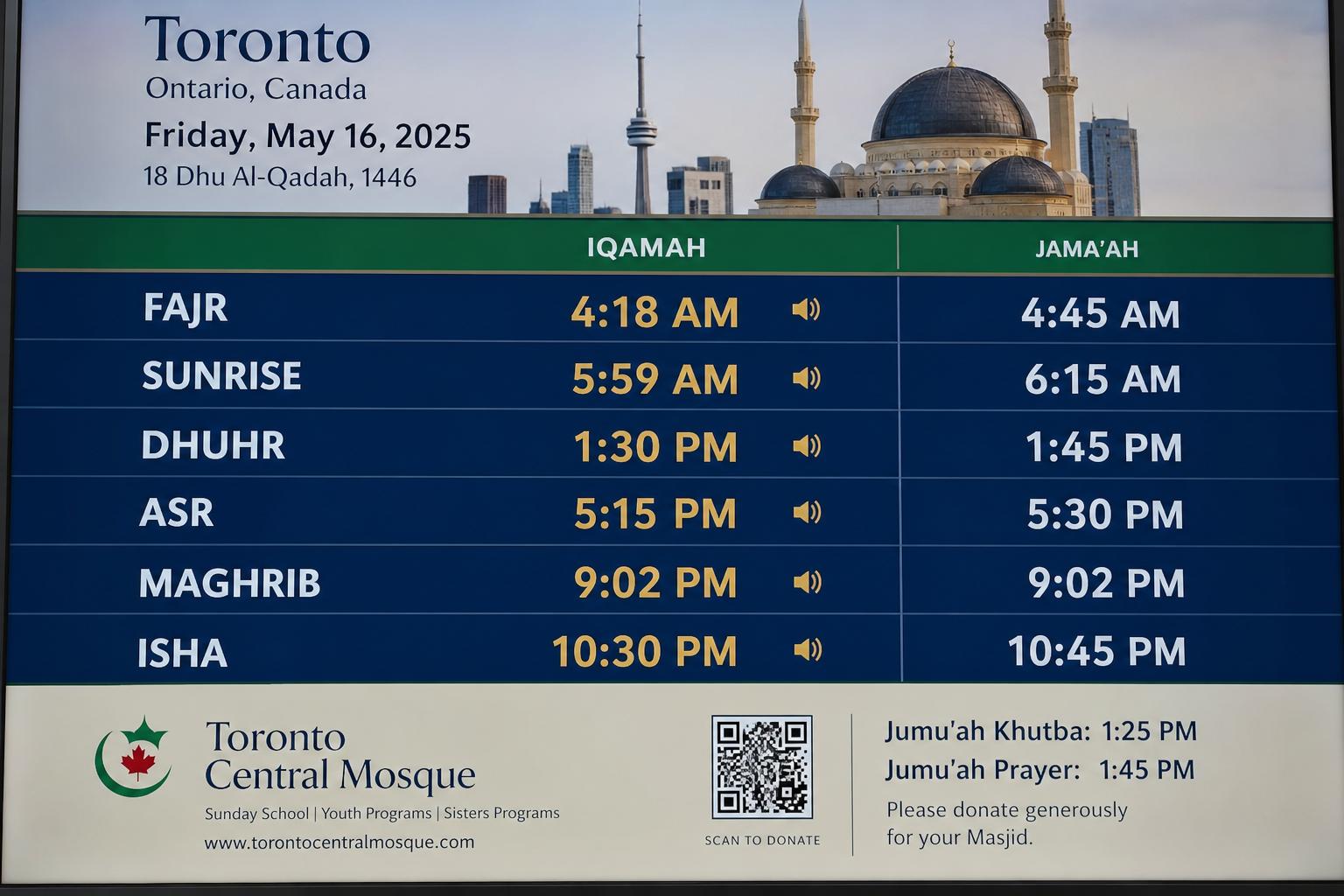
Toronto’s days swing wide. In June, sunset lingers past nine and Isha edges late into the night. In December, Maghrib feels like it sneaks up mid‑afternoon. If you’re trying to keep a steady prayer rhythm in a city like this, “good enough” timetables won’t cut it. You need accuracy you can trust, settings you understand, and a routine that holds up through every season, workday, commute, snowstorm, and Ramadan night. This guide breaks down everything you need to know about prayer times Toronto: how they’re calculated, how they shift through the year, which settings make sense for Canada, and how to make those times live comfortably in your day.
Expect real details, not placeholder advice. We’ll cover calculation methods used in Canada, what Hanafi vs Shafi/Maliki means for Asr, high‑latitude rules (yes, they matter here too), daylight saving time in Ontario, how to set your app so it matches local mosques, and practical strategies for praying at work or school under Ontario’s human rights framework. By the end, you’ll know exactly how to get today’s Toronto prayer times fast—and how to make them stick in real life.
What “Prayer Times” Actually Mean in Daily Life
Five daily prayers define the rhythm of a Muslim day. Each has a start time and an end time (a window), based on the sun’s position. The adhan usually announces the start; iqamah is the congregation’s standing time in a mosque, which is later. When you search “prayer times Toronto,” you’re usually getting the start times. If you’re heading to a masjid, check their posted iqamah times, which change throughout the month.
Here’s what the windows mean in plain language:
- Fajr: Begins at true dawn when a horizontal light appears (astronomical twilight at a defined angle below the horizon). Ends at sunrise. If you’re fasting, Fajr is also your cut‑off for suhoor.
- Dhuhr: Begins just after the sun passes its highest point (solar noon). Ends when Asr starts.
- Asr: Begins when an object’s shadow reaches a certain length relative to its noon shadow. There are two juristic standards:
- Shafi/Maliki/Hanbali (Asr 1): Start when the shadow equals the object’s length (plus the noon shadow).
- Hanafi (Asr 2): Start when the shadow is twice the object’s length (plus the noon shadow).
- Maghrib: Begins at sunset when the sun’s disk is fully below the horizon. Ends when Isha begins.
- Isha: Begins when twilight fully disappears (the sky is truly dark by a defined angle). Ends at Fajr.
In Toronto, many mosques with South Asian roots list Asr using the Hanafi standard. Others, especially those aligned with Shafi or Maliki practice, may use Asr 1. Some post both. If you pray with a congregation, follow their posted schedule. If you pray at home, pick the juristic method your fiqh follows and keep it consistent.
How Prayer Times Are Calculated in Toronto
Getting accurate salah times in Toronto is mostly astronomy and a little geography. The city sits around 43.65°N, 79.38°W in the Eastern Time Zone (America/Toronto). Ontario observes daylight saving time—from the second Sunday in March to the first Sunday in November—so your clock jumps ahead by an hour in spring and back in fall. Any app or website worth using accounts for this automatically.
The core of the calculation uses:
1) your latitude and longitude (Toronto and the wider GTA),
2) the date (which drives the sun’s declination),
3) your time zone and DST status,
4) a calculation method that sets Fajr and Isha angles, and
5) your Asr juristic preference.
The math turns the sun’s altitude (an angle) into local times when those angles occur.
Fajr and Isha times depend on how many degrees below the horizon the sun sits. You’ll see options like 15°, 17°, 18°. Bigger angles push Fajr earlier and Isha later, because they wait for deeper darkness. Toronto’s community typically relies on a small set of standards used across North America. Choosing one method consistently matters more than hopping between them—consistency keeps your body clock and planning stable.
Common Calculation Methods Used in Canada
Most prayer apps and websites let you choose from well‑known methods. Here are the ones you’ll encounter most often in the Canadian context, and what they mean for Fajr and Isha:
| Method | Fajr Angle | Isha Angle/Interval | Notes for Toronto |
|---|---|---|---|
| ISNA (North America) | 15° | 15° | Widely used by North American communities; many GTA masajid align with it. |
| Muslim World League (MWL) | 18° | 17° | Slightly earlier Fajr, slightly later Isha than ISNA. |
| Egyptian General Authority of Survey | 19.5° | 17.5° | Even earlier Fajr and later Isha; used in some regions, less common locally. |
| Umm al‑Qura (Makkah) | 18.5° | Fixed interval after Maghrib | Best for Saudi Arabia; not ideal for Canada’s latitude. |
| University of Islamic Sciences, Karachi | 18° | 18° | Common in South Asia; workable here but less standardized locally than ISNA/MWL. |
If your mosque posts a timetable, use the same method they use so your adhan line‑up is consistent with your local congregation. If you don’t know, ISNA or MWL is a practical starting point for “prayer times Toronto,” with Asr set to Hanafi if that matches your practice.
High‑Latitude Adjustments and Why They Matter Here
Toronto is not extreme latitude, but our summers stretch twilight late and pull dawn early. On some nights around late June, twilight feels endless. In strict astronomical terms, Toronto still gets “true night,” but the window between Isha and Fajr can be small. High‑latitude rules tell your app what to do if defined angles don’t occur or are awkward—especially relevant for cities north of us, but still worth setting here for consistency.
Common rules include:
– Angle‑based: Sets Fajr/Isha at proportional segments of the night tied to the chosen angle.
– Middle of the Night: Splits the time between sunset and sunrise in half for Isha and Fajr.
– One‑Seventh of the Night: Uses a seventh of the night length as a buffer.
For Toronto, “Angle‑based” is a safe, widely recommended choice, especially if you’re on ISNA or MWL.
Asr: Hanafi vs Shafi/Maliki in Practice
Asr shifts the most by madhhab. On a typical Toronto day, Hanafi Asr can start notably later than Shafi/Maliki Asr, sometimes by 30–60 minutes depending on the season. Many GTA mosques—particularly those with South Asian congregations—follow Hanafi. Some post both start times and choose one iqamah time that works for their community. If you attend a mosque’s congregation, follow their posted iqamah. If you’re at work or home, use the Asr method your fiqh follows and keep it steady through the year.
Seasonal Patterns You Can Plan Around in Toronto
You don’t need exact times memorized, but understanding how they swing helps a lot with sleep, commutes, school, and Ramadan planning. Here’s what the year looks like in broad strokes within the GTA (Toronto, Mississauga, Brampton, Scarborough, North York, Markham, and nearby areas):
Summer (late May to July):
– Maghrib is late—often around 9 pm or a touch later near the solstice.
– Isha can be very late (near 11 pm, depending on your calculation method).
– Fajr is very early (around 3:30–4:30 am).
That’s a squeeze: late Isha and early Fajr. If you’re fasting in June, plan sleep in two chunks or nap after work if needed. Apps with reliable reminders matter most in this season.
Winter (November to January):
– Maghrib is early (roughly 4:30–5 pm at the earliest weeks of December).
– Isha follows soon after (often in the early evening).
– Fajr moves later (closer to 6–7 am).
Here, the challenge flips. The day is short, so Dhuhr and Asr land squarely in work or class time. Use predictable breaks and a private space, and consider a lighter lunch to leave room for wudu and salah without feeling rushed.
Spring and Autumn Transitions:
– Times shift rapidly week‑to‑week.
– Daylight saving time adds a one‑hour clock change in March and November that your app should handle automatically.
Update any printed schedule monthly, not yearly, during these swings. A screenshot from last Ramadan won’t work this fall.
Getting Today’s Toronto Prayer Times—Fast
The quickest, reliable ways to get “prayer times Toronto” today:
- Check your local mosque’s website or noticeboard. Many publish monthly PDFs with adhan and iqamah times. Well‑known GTA masajid update these regularly.
- Use a trusted prayer app set to “America/Toronto” with ISNA or MWL, Asr method as needed, and high‑latitude “Angle‑based.” Enable location and automatic DST.
- Search engines often display a daily box for “Toronto prayer times today.” Cross‑check once with your app’s method; then use the one source consistently.
- Voice assistants on your phone or smart speaker can surface times if your location is on and your default method is set.
Consistency is everything. Pick one authoritative source and stick to it. If you split between different methods, you’ll create confusion for yourself—especially around Isha and Fajr in summer and Asr all year.
Step‑by‑Step: App Settings That Match the GTA
To make sure your prayer times in Toronto are spot‑on:
- Allow location access. A few meters won’t matter, but you do want the app locked to the GTA rather than a generic “Ontario.”
- Time zone: Set to America/Toronto. Do not hard‑code an offset; let the app track DST automatically.
- Calculation method: Choose ISNA (North America) or Muslim World League. If your local masjid posts a method, match it.
- Asr method: Hanafi if your practice or mosque uses it; Shafi/Maliki otherwise. Stick with one.
- High‑latitude rule: Angle‑based (good balance in Canadian cities).
- Time format: 12‑hour or 24‑hour—pick what you read fastest and use it across devices.
- Notifications: Set gentle alerts for adhan and a second alert for your personal iqamah at home or office.
Optional extras:
– Add a pre‑Fajr alert 15 minutes before Fajr for suhoor year‑round (handy even outside Ramadan if you want extra morning dhikr).
– Enable quiet hours if late Isha notifications wake kids or roommates—set a vibration‑only alert.
Add Prayer Times to Your Calendar and Watch
For people who live by their calendars, subscribe to a dynamic feed (many apps or services provide ICS links) that populates Fajr, Dhuhr, Asr, Maghrib, and Isha each day. Sync it with Google Calendar or Apple Calendar and show it on your smartwatch. It keeps the day framed correctly even when you’re buried in meetings or errands. Double‑check after software updates that DST and location still sync correctly.
Mosques and Real‑World Iqamah Times in the GTA
Adhan starts the prayer window. Iqamah is when the congregation lines up. They’re not the same, and the gap changes through the year to match commute patterns and daylight. Downtown mosques often set Dhuhr iqamah a few minutes after adhan on weekdays so office workers can pop in and out. In suburban masajid, Asr and Isha iqamah may be longer after the adhan in summer to give families time to arrive.
Friday (Jumu’ah) is different again. Many Toronto and Mississauga mosques run two or more khutbahs to handle crowds and work schedules. Lunchtime capacity is tight downtown, so expect lines and plan wudu before you go. In winter, the earlier sunset can squeeze between Jumu’ah and school pick‑up; watch those windows if you’re rushing back to the office or daycare.
Whenever possible, check the latest iqamah times on your mosque’s monthly timetable rather than assuming last month’s pattern. When snow hits hard or freezing rain rolls in, some mosques combine Maghrib and Isha or adjust iqamah on short notice for safety. Winter in Ontario is real; so is the community’s flexibility.
Work, School, and the Law: Your Rights to Pray in Ontario
In Ontario, “creed” is a protected ground under the Ontario Human Rights Code. That means employers, schools, and service providers have a duty to accommodate sincerely held religious practices—like daily prayers—short of undue hardship. The bar for “undue hardship” is high and tied to specific factors. Practically, that opens the door for small schedule adjustments and quiet spaces to pray.
How that looks day‑to‑day:
- Work breaks: The Employment Standards Act sets minimum standards for eating periods (a 30‑minute break within every five hours of work). With agreement, that break can be split into two 15‑minute periods. Many employers, even beyond the minimum, allow short, predictable pauses—use them for Dhuhr or Asr and keep it consistent.
- Space: A small meeting room or wellness room can serve as a prayer space. It doesn’t need to be permanent; predictability matters more. Ask respectfully, suggest safe, low‑traffic rooms, and be clear about timing and duration.
- Schools: Ontario school boards—including large boards like TDSB and Peel—publish religious accommodation guidelines. Many schools coordinate weekly Jumu’ah or offer supervised space for Dhuhr/Asr as needed.
Tips for a smooth request:
1) Put it in writing; be specific about times and duration.
2) Offer solutions (e.g., “I can shift lunch 15 minutes later”).
3) Be flexible about room options and exact minutes when business needs spike.
4) Keep it brief; a punctual routine builds trust.
This is general information, not legal advice. If you face pushback, document your steps and consult your HR office or a legal clinic familiar with Ontario human rights law.
Wudu on the Go: Practical Tips for a Busy City
Praying at the right time is easier when wudu isn’t a hassle. A few small habits help in Toronto’s work and transit reality:
- Carry a compact travel mat and a small, sealable water bottle. Washrooms in office towers and malls are usually clean; avoid peak times if you can.
- Use paper towels kindly and wipe up if you splash. A considerate routine protects everyone’s access to shared spaces.
- If you follow the fiqh that allows wiping over socks (khuff/masah conditions), plan ahead: put them on after a full wudu and know your time window. It’s practical for winter boots and long commutes.
- Keep a spare pair of socks and a microfiber cloth in your bag. Toronto slush seasons are not gentle on footwear.
- If water access is truly unavailable or unsafe, review tayammum rulings for your school of law with a local imam. It’s rare in the city but useful knowledge for emergencies.
Ramadan in Toronto: Suhoor, Iftar, and Night Prayers
Ramadan puts a spotlight on accurate “prayer times Toronto.” Suhoor ends at Fajr; iftar begins at Maghrib. The long summer days in some years make suhoor early and iftar late; winter Ramadans swing the other way. Mosques across the GTA host community iftars—some weekly, some nightly—often free or donation‑based. They announce these on social media and posters; check before you go if you have dietary needs or accessibility questions.
Taraweeh typically begins after Isha, with schedules shifting as Isha moves earlier or later through the month. In severe weather, or when transit delays stack up, communities adjust. Don’t be shy to ask your local masjid what calculation method underpins their Ramadan timetable; match your home app to it so suhoor and iftar alarms line up exactly.
Moon‑sighting vs calculation: Within the GTA, some communities follow global moonsighting, others follow regional sightings, and some follow calculation‑based announcements (like the Fiqh Council of North America). Expect variation in start/end dates between masajid. Follow your mosque or scholarship—and confirm Eid prayer times early. Popular venues fill fast, and many centers run multiple Eid shifts.
Travel and Day Trips Around the GTA
Within the GTA and Golden Horseshoe—Toronto, Mississauga, Brampton, Vaughan, Markham, Richmond Hill, Oakville, Burlington, Pickering, Ajax, Whitby, Oshawa, and up to Hamilton—sunrise and sunset vary by only a few minutes. Your prayer app will adjust times based on your GPS even as you drive.
Head a bit farther:
– Cottage country (Barrie, Orillia, Muskoka): still Eastern Time, a few minutes difference.
– Niagara Region: still Eastern Time; minimal shift.
– Ottawa and Montreal: same time zone; small east‑west differences of a few minutes in adhan times.
– Cross into the U.S. at Niagara Falls or Buffalo: same time zone, but roaming could change your phone’s reported location. Force‑update your app’s location once you settle to avoid oddities.
Flying west (Winnipeg, Calgary, Vancouver) or east (Halifax, St. John’s), time zones change. Make sure your app tracks the new zone and method. If you’re traveling enough to qualify as a musafir according to your fiqh, you may have the option to combine Dhuhr with Asr and Maghrib with Isha. Plan those windows around flights and security lines. When a storm shuts things down—as it often does in Canadian winters—stay safe and flexible. Many travelers keep a printed mini‑schedule as a backup in case phones die.
Advanced: How the Math Works (Plain English)
Behind every “Toronto prayer times” result is astronomy. Here’s the short tour, without the heavy formulas:
- Solar declination: The sun’s apparent tilt changes through the year as the Earth orbits. That’s why our days stretch in June and shrink in December.
- Solar noon: The moment the sun crosses your local meridian in the sky. Because Toronto sits west of the Eastern Time zone’s reference meridian (−75°), solar noon in Toronto happens later than 12:00 by the clock—roughly 15–20 minutes offset, plus a small seasonal “equation of time” wobble.
- Sunrise and sunset: Defined with a standard correction for atmospheric refraction and the sun’s apparent radius. Apps bake these in, so you don’t have to.
- Twilight and angles:
– Fajr corresponds to the sun at a set depression angle below the horizon (e.g., 15–18°).
– Isha mirrors that on the evening side.
Larger angles mean the sky must darken more, so Fajr is earlier and Isha is later. - Asr: Tied to the length of your shadow. At solar noon, an object’s shadow is shortest. As the sun lowers, the shadow grows. When it reaches 1× (Shafi/Maliki/Hanbali) or 2× (Hanafi) the object’s length, Asr begins.
- Time zone and DST: After the raw solar times are computed, the app converts them into local clock time using America/Toronto rules for daylight saving. That’s why “never hard‑code UTC offsets” is good advice—DST will blow up your manual math twice a year.
If you ever wonder why two apps disagree by a few minutes, you can usually trace it to:
1) different angles for Fajr/Isha,
2) different Asr methods,
3) high‑latitude rule differences, or
4) rounding to the nearest minute versus next minute.
Once you pick your standard, those small gaps disappear from daily life.
Common Mistakes and How to Avoid Them
A few predictable missteps cause most of the “why is my time off?” headaches. Save yourself the trouble:
- Using a screenshot from last year’s Ramadan timetable. Times change daily. Outdated charts are worse than none.
- Mixing calculation methods. If your masjid uses ISNA and your phone uses MWL, your Fajr and Isha won’t line up. Match them once and be done.
- Forgetting daylight saving time. Let your app manage DST through the America/Toronto time zone, not a manual GMT offset.
- Choosing the wrong city. “Toronto, Ohio” is a real place. Make sure your GPS or city selection is actually Toronto, Ontario.
- Confusing adhan and iqamah. If the poster says Isha iqamah is at 10:45, that’s not the start of the prayer window; it’s the jama’ah time. The start (adhan) is earlier.
- Missing the Asr method. If you pray Hanafi at home but follow Shafi timings by accident, your Asr will drift earlier than intended.
- Ignoring high‑latitude settings. Even in Toronto, these options stabilize your summer schedule.
Building a Routine That Sticks in a Toronto Life
Accuracy gets you the times; habit keeps you praying on time. A few structures help when work, transit, and family needs collide:
- Pair each prayer with an anchor activity. Fajr with coffee and a short reading. Dhuhr with a quick stretch. Asr with an afternoon reset. Maghrib with dinner. Isha with a wind‑down routine.
- Use two reminders per prayer: one at adhan, one when you realistically can pray. In long meetings, that second nudge saves the day.
- Batch wudu with breaks. If you have back‑to‑back commitments, make wudu just before they start. You’ll be ready when the window opens.
- Keep a tiny kit: travel mat, socks, small bottle, and a micro‑towel. Toronto weather is unpredictable; your kit shouldn’t be.
- For families, post this week’s prayer times on the fridge, updated every Sunday night. Simple visibility works wonders.
Qibla in Toronto: Getting Your Direction Right
In Toronto, the Qibla is generally toward the northeast—many people are surprised by that if they assumed southeast. Mosques mark Qibla direction in their prayer areas; at home, use a reliable Qibla app or a compass and calibrate carefully. Nearby tall buildings, metal frames, or smartphones with uncalibrated sensors can nudge readings by a few degrees. If you’re unsure, check two different sources and split the difference. Consistency beats perfection measured to the decimal.
Choosing Tools You Can Trust
Good sources for “prayer times Toronto” combine solid astronomy, correct time zone logic, and community‑recognized methods. Look for:
- Transparent settings: Fajr/Isha angles, Asr method, and high‑latitude rule should be visible and changeable.
- Time zone correctness: Uses America/Toronto with up‑to‑date DST rules.
- Local alignment: Option to match ISNA (North America) or MWL easily.
- Data portability: ICS feeds for calendars, and widget or watch support for quick checks.
If your app supports custom angles, set exactly what your mosque uses and save it as “Toronto profile.” When you travel, switch profiles rather than editing every field on the fly.
A Note on Safety and Winter Reality
Toronto winters mean slick sidewalks, dark commutes, and sudden weather. Many mosques adjust schedules or combine prayers during ice storms or heavy snow to reduce travel risk. At home, take more care with wudu on slippery floors and give yourself extra time for Maghrib when rush hour traffic is slow. If transit delays keep you from your planned congregation, you still have the full window to pray—use it wisely and safely.
At a Glance: How to Get Accurate Prayer Times in Toronto Today
Need a quick summary?
- Open a reliable prayer app and enable location for Toronto, Ontario.
- Set calculation method to ISNA (North America) or MWL. Pick one and keep it.
- Select Asr method: Hanafi or Shafi/Maliki—match your practice or mosque.
- Set high‑latitude rule to Angle‑based. Ensure America/Toronto time zone with automatic DST.
- Check today’s schedule; add reminders. If you attend a mosque, verify their iqamah times and plan travel.
That’s it. You’re aligned with how most of the GTA prays, and your times will stay trustworthy all year.
FAQ
What time is Fajr in Toronto today?
It changes daily and swings widely between winter and summer. Open a prayer app set to Toronto with ISNA or MWL and your Asr method, or check your local mosque’s daily timetable. If you’re fasting, set a pre‑Fajr alert as a suhoor cut‑off to avoid last‑minute rushing.
Which calculation method do Toronto mosques use?
Many use ISNA (North America). Some use Muslim World League or publish custom angles. Check your mosque’s timetable or website—most list the method somewhere on the chart. Match your app to theirs so your adhan and their iqamah feel coherent throughout the month.
Do I follow Hanafi or Shafi for Asr in the GTA?
Follow your fiqh. Many GTA congregations—especially with South Asian heritage—use Hanafi Asr (shadow 2×). Others use Shafi/Maliki (shadow 1×). If you join a congregation, pray with their schedule; at home or work, choose your juristic method and keep it consistent in your app.
How does daylight saving time affect prayer times Toronto?
Ontario observes DST from the second Sunday in March to the first Sunday in November. Your app should apply this automatically via the America/Toronto time zone. Avoid manual GMT offsets; they will be wrong half the year.
Is the Qibla in Toronto southeast or northeast?
Northeast. Use a Qibla app or marked mosque indicators. Calibrate your phone’s compass and avoid standing near large metal objects when taking a reading.
Are Toronto and Mississauga prayer times the same?
They’re very close—within a couple of minutes—because they share the same time zone and are only a few kilometers apart. Location‑aware apps will account for the tiny difference automatically.
How do I get a Ramadan timetable for Toronto?
Download the monthly PDF from your mosque or set your app to the same calculation method they use. Suhoor ends at Fajr, iftar begins at Maghrib, Taraweeh is after Isha. Expect different communities to follow different moon‑sighting or calculation approaches; confirm with your imam so your calendar matches your congregation.
Can I pray at work or school in Ontario?
Yes. Under the Ontario Human Rights Code, creed is protected. Employers and schools have a duty to accommodate sincerely held religious practices short of undue hardship. In practice, brief breaks and a quiet room are common solutions. Coordinate respectfully, put requests in writing, and keep to agreed times. This is general information, not legal advice.
Why do two apps show different Toronto prayer times?
Likely different Fajr/Isha angles, Asr method, or high‑latitude rules. Set both apps to the same method (e.g., ISNA), match the Asr juristic option, and ensure America/Toronto time zone with DST. The gap should shrink to a minute or two, usually due to rounding.
What’s the easiest way to remember every prayer on time in this city?
Use dual reminders (adhan and a practical follow‑up), pair each prayer with a daily anchor activity, and keep a simple wudu kit. Sync prayer times into your calendar and watch so they’re visible inside your normal planning tools. Consistency beats heroics.
Do I need high‑latitude settings in Toronto?
They help stabilize Isha and Fajr in summer, when nights are short. Choose “Angle‑based” if your app offers it. It’s especially useful if you travel elsewhere in Canada where nights may not fully darken.
Where can I see Toronto prayer times for the whole month?
Many GTA mosques publish monthly PDF timetables with adhan and iqamah. You can also use apps that export monthly schedules or generate printable calendars. Re‑download each month; times shift from page to page as the season changes.
Are there multiple Jumu’ah khutbahs in downtown Toronto?
Often yes. High‑demand mosques frequently run two or more Friday shifts to accommodate office worker schedules and capacity. Check the mosque’s site or posters for this week’s start times and plan wudu in advance to save time.
How early can I pray Maghrib if I’m stuck on the TTC?
Maghrib begins at sunset, not a minute before. If you can’t reach a mosque, pray as soon as the sun sets. A small travel mat works on clean, safe surfaces; otherwise, exit at a station with a quiet corner and finish quickly. Safety first, always.
Any final setup tip for “prayer times Toronto” that people miss?
Make sure your phone’s system time is set to “automatic” and the time zone is America/Toronto. If your system clock is off—even by a few minutes—your well‑configured app will still alert at the wrong time. Calibrate once, and you’re set for the year.