
XLM Price CAD: A Clear, Practical Guide for Canadians Tracking Stellar Lumens in Canadian Dollars
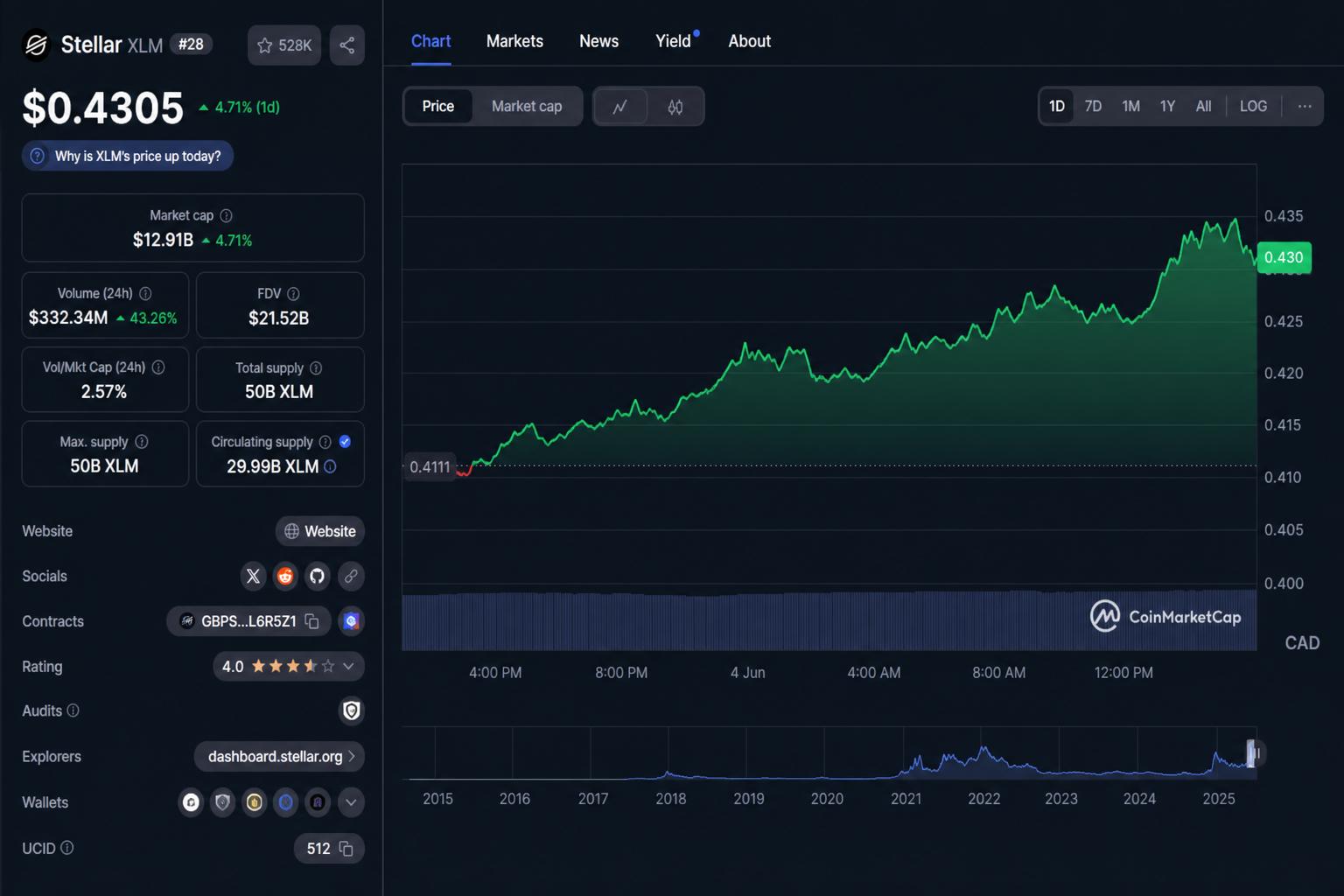
XLM price CAD. It’s a simple phrase with a lot baked in. You’re trying to see what one unit of Stellar Lumens (XLM) costs in Canadian dollars, compare prices across platforms, understand why it moves, and figure out how to buy or sell without getting dinged by hidden fees or awkward conversions. This guide brings all of that into one place for a Canadian audience—what XLM is, how its CAD price is set, which platforms and tools Canadians use, what taxes and rules apply here, and how to act on the information without stepping on landmines.
You’ll find plain-English explanations, real-world examples in CAD, up-to-date regulatory context, and practical tactics to help you make sense of the market. Whether you want to quickly check the xlm price cad right now or you’re building a longer-term strategy, this is for you.
Quick Start: How to See XLM Price in CAD Right Now
If you’re looking for a fast answer, you have a few reliable options to check the latest XLM price CAD without signing in anywhere:
- Price aggregators: CoinGecko, CoinMarketCap, and TradingView display XLM in many fiat currencies, including CAD. Search “XLM CAD” and you’ll get a live quote, 24-hour change, market cap, and charts.
- Crypto trading platforms that serve Canadians: Many display public prices before login. Select the XLM/CAD market, if available, or view XLM in USD and convert to CAD (more on this below).
- Financial apps and widgets: Some Canadian fintech apps and browser extensions let you set default currency to CAD for quick checks.
Tip: If you only see XLM in USD on a site, you can estimate XLM price in CAD using cross rates:
XLM/CAD = XLM/USD × USD/CAD exchange rate
For example, if XLM = 0.12 USD and USD/CAD = 1.35, then XLM ≈ 0.162 CAD. Your result will differ slightly from platform quotes due to spreads and fees, but it’s a fast ballpark.
Stellar (XLM) in Plain Terms—and Why Canadians Care
Stellar is a payment-focused blockchain that aims to make cross-border transfers fast and inexpensive. It’s built around a federated Byzantine agreement model called the Stellar Consensus Protocol—engineered for speed and low fees rather than energy-intensive mining. XLM is the native asset that pays transaction fees and helps prevent network spam.
Why does this matter in Canada? Canada is a trading nation with a diverse immigrant community. People regularly move money abroad and back home. Traditional transfers can be slow and expensive, and fees bite harder when you’re sending smaller amounts. Stellar’s pitch: near-instant settlement and tiny on-chain fees measured in fractions of a cent. The network also supports fiat-backed tokens like USDC on the Stellar network, which can simplify digital dollars moving across borders. As adoption grows, interest grows—and so does the attention on the xlm price cad.
Beyond remittances, builders use Stellar for payment rails, digital wallets, and, more recently, smart contracts via Soroban (launched on mainnet in 2024), expanding what can be built on the network. All of that can influence sentiment and, indirectly, price.
What “XLM Price CAD” Really Means
The “xlm price cad” you see isn’t a single universal number. It’s a live market price from a specific venue and currency pair. Here’s what drives the variations:
Direct XLM/CAD Pairs vs. Cross Rates
Some Canadian platforms list XLM/CAD directly. Others might list XLM/USD only. If there’s no XLM/CAD pair, platforms can show a synthetic CAD value using the latest USD/CAD rate. This creates slight differences between a direct CAD market and a cross conversion.
Consider two paths to price discovery:
- Direct: Buyers and sellers trade XLM against CAD. The order book reflects actual Canadian-dollar demand for XLM. Spread and depth depend on local liquidity.
- Cross: Platforms quote XLM in USD and then convert USD to CAD for display. Your trading and settlement may still occur in USD or a stablecoin, which can introduce extra FX steps and fees if you deposit/withdraw in CAD.
In practice, both methods usually land near the same number. But for active traders, even a small difference can matter.
Spreads, Liquidity, and Slippage in Canada
The more buyers and sellers on a pair, the tighter the spread (the gap between the best bid and best ask). On an active direct XLM/CAD market, spreads can be narrow. On thinner markets, a market order may move price more than you expect—called slippage. Placing limit orders lets you control your execution price and reduce surprises.
Many Canadian platforms route orders to their own order book and/or external liquidity. Depth improves during North American trading hours when more participants are active. If you place larger orders, check the order book first to estimate impact or break the order into chunks.
A Quick, Realistic Example
Suppose the visible “xlm price cad” is 0.16 CAD. You fund a Canadian platform by Interac e-Transfer with no deposit fee. The platform charges a 0.2% taker fee. You place a market buy for 5,000 XLM.
- Nominal cost at quote: 5,000 × 0.16 = $800.00 CAD
- Taker fee: 0.2% × $800.00 = $1.60 CAD
- Assume a 0.4% spread and minor slippage on a market order: ~0.4% × $800 = $3.20 CAD implicit cost
- Estimated total: $804.80 CAD for 5,000 XLM (effective price ~0.16096 CAD/XLM)
If you used a limit order at 0.159 CAD and it filled, your cost could be lower but there’s no guarantee you get filled right away—or at all. Real trading is a trade-off between certainty and precision.
Where Canadians Can View and Trade XLM in CAD
In Canada, crypto platforms operate under guidance from the Canadian Securities Administrators (CSA) and typically register as restricted dealers with provincial securities regulators, alongside being Money Services Businesses (MSBs) with FINTRAC. Availability of specific assets like XLM can vary by platform and can change. Always check the current supported asset list before funding.
As of recent years, several recognized platforms serve Canadians and offer CAD rails such as Interac e-Transfer, bank transfer, and wire. Examples include platforms that have publicly announced registrations or operations in Canada; however, this is not an endorsement and listings can change. Evaluate:
- Registration and regulatory status (CSA/OSC/AMF or other provincial regulators, and FINTRAC MSB)
- Whether XLM is supported for buy/sell, deposits, and withdrawals (on-chain)
- Fees: trading, spreads, funding, and withdrawal fees (both fiat and crypto)
- Funding speed and reliability (Interac e-Transfer availability, daily limits)
- Security practices (cold storage, insurance, proof-of-reserves disclosures, 2FA enforcement)
If you prefer not to create an account yet, you can still monitor the xlm price cad using public tickers on aggregator sites or by viewing the platform’s markets page. When you’re ready to trade, verify KYC requirements and supported provinces (including Quebec) before you deposit funds.
Funding Methods Canadians Commonly Use
Common CAD funding options include:
- Interac e-Transfer: Fast for smaller amounts; often free or low cost; daily limits vary by platform and your bank.
- Bank transfer (EFT): Typically free; may take 1–3 business days to settle.
- Wire transfer: Suitable for larger amounts; fees vary by bank; wires are fast once processed.
- Debit: Sometimes supported, but fees can be higher and banks may set their own restrictions.
- Credit cards: Many Canadian banks block crypto purchases via credit card or treat them as cash advances with added fees and interest from day one—check with your issuer.
Remember, if you fund in USD or stablecoins and your goal is CAD, you’ve added an FX or conversion leg. If your goal is to track or trade the xlm price cad specifically, funding and settling in CAD can simplify your accounting and reduce conversion costs.
Withdrawals and Self-Custody
With XLM, deposits and withdrawals often require a memo (or destination tag) when sending to an exchange or custodial wallet. If the memo is missing or incorrect, your funds can be delayed or lost. Double-check the deposit instructions on the receiving platform each time—memos can be unique to your account. For self-custody, use a reputable wallet that supports Stellar. Back up your seed phrase securely and enable strong security on any device you use to sign transactions.
Taxes and Regulation in Canada: What You Need to Know
It’s not glamorous, but it’s essential. Canada treats crypto as a commodity for tax purposes. The Canada Revenue Agency (CRA) expects proper records and reporting. Here’s the high-level picture; consult a qualified tax professional for your situation.
Capital Gains vs. Business Income
When you dispose of XLM—by selling it for CAD, swapping it for another crypto, or spending it—you may realize a gain or loss. For many individual investors, this is a capital gain or capital loss. If your activity is frequent, organized, and business-like, the CRA may treat it as business income, which is fully taxable. Capital gains are generally 50% taxable. Classification depends on intent, frequency, holding period, and other factors. Keep reliable documentation.
Adjusted Cost Base (ACB) and Recordkeeping
Canada uses the ACB method for identical property. That means if you buy XLM at different times and prices, you track a single pooled cost base, adjusted for purchases, sales, and fees. When you sell part of your XLM, you calculate the gain using the average cost of your total XLM holdings, not the specific lot you sold (unless your records and tax position allow specific identification, which is generally not the default in Canada).
Keep detailed records: dates, amounts, CAD values at time of each transaction, wallet addresses, transaction IDs, and fees. Many Canadians export CSVs from their platform and reconcile with a crypto tax tool. Make sure the tool supports ACB and Canadian rules.
Superficial Loss Rule
Canada’s superficial loss rule can apply to crypto: if you sell XLM at a loss and you (or an affiliated person) buy the same or identical property within 30 days before or after the sale, the loss may be denied and added to your ACB. This rule exists to prevent taxpayers from harvesting losses without actually changing their position. If you actively tax-loss harvest, plan carefully and get advice.
GST/HST and Using Crypto to Pay for Goods
If you accept XLM as payment in a business context, you recognize income at the fair market value in CAD when received, and GST/HST may apply as it would for the underlying goods or services. The crypto angle doesn’t remove your normal tax obligations.
Foreign Reporting (T1135) Considerations
If you hold significant crypto on foreign platforms, you may need to file a T1135 for specified foreign property when total cost amounts exceed CAD $100,000 at any time during the year. Application to crypto can be fact-specific—where assets are held and how. Speak to a tax professional about your circumstances.
Regulatory Oversight and Compliance
Canadian crypto trading platforms typically operate under CSA oversight as registered restricted dealers (or similar frameworks) and as MSBs with FINTRAC. They must implement KYC/AML programs and comply with the Travel Rule for virtual asset transfers. Expect ID verification and, at times, source-of-funds questions for large deposits or withdrawals. This is normal under Canadian law.
Quebec residents are generally covered through local oversight by the Autorité des marchés financiers (AMF). Confirm that your chosen platform serves Quebec and that XLM is supported. Regulations evolve, so policies and listings can change over time.
Stablecoins (termed “value-referenced crypto assets,” or VRCAs) are subject to an interim CSA approach. Platforms may place conditions on which stablecoins are offered and how they can be used. This can influence liquidity paths between XLM and CAD if you use stablecoins as an intermediate step.
What Moves the XLM Price in CAD?
The xlm price cad rides on both crypto dynamics and Canadian currency dynamics. Here are the big levers.
Crypto Market Beta
XLM tends to correlate with the broader crypto market—especially Bitcoin and Ethereum. When BTC rallies on a macro catalyst or institutional flows, many altcoins rise with it; the reverse is also true. Macro risk sentiment, global liquidity conditions, and headline flows often matter more than project-specific news on any given day.
Network Fundamentals
Stellar’s value proposition is low-cost global payments. Adoption by wallets, remittance providers, and fintechs can lift sentiment. Network usage metrics—transaction counts, active addresses, issuance and redemption of fiat tokens like USDC on Stellar, and the growth of Soroban-based applications—are worth watching. If developers and payment companies build more on Stellar, the narrative strengthens.
Supply Dynamics
Stellar doesn’t use mining. A large portion of XLM was created at inception. In 2019, half the supply was removed via a burn, leaving a lower total supply. There’s no ongoing inflation through mining rewards, and base fees are burned, slightly reducing supply over time. The Stellar Development Foundation (SDF) holds a meaningful share of XLM to fund ecosystem growth, which can influence perceptions of supply overhang depending on transparency and grants.
CAD/USD Foreign Exchange Effects
Even if XLM/USD is flat, XLM/CAD can move because CAD moves. When the Canadian dollar strengthens against the U.S. dollar (for example, on higher oil prices or Bank of Canada policy changes), the CAD price of XLM can fall—without any change in USD terms. Keep an eye on USD/CAD, especially if you price everything in Canadian dollars.
Regulatory Headlines and Partnerships
Announcements about regulatory clarity, payments partnerships, integrations with remittance networks, or major wallet launches can sway sentiment. Conversely, exchange delistings, platform outages, or adverse headlines can weigh on price. In Canada, rule changes affecting stablecoins, leverage, or asset listings can ripple into how and where Canadians access XLM.
How to Analyze XLM Price CAD Like a Pro (Without Overcomplicating It)
Technical Analysis Basics on CAD Pairs
Look at an XLM/CAD chart on a platform that supports TradingView or a similar charting tool. Start simple:
- Identify trend with moving averages (e.g., 50-day and 200-day). Crossovers can hint at momentum shifts.
- Use support and resistance zones drawn from prior swing highs/lows. These are areas where traders previously changed their minds.
- Check RSI for overbought/oversold context, but don’t treat it as gospel. Momentum can stay stretched in strong trends.
- Volume confirms moves. Big candles without volume carry less weight.
Focus on the CAD pair if your base currency is CAD. If your platform only has USD charts, that’s still helpful—just remember the FX overlay when you bring conclusions back to Canadian dollars.
On-Chain and Network Metrics
For a payment network like Stellar, consider:
- Daily transactions and fee levels (consistently low fees can be a feature, but spikes may draw attention).
- Active accounts and new account growth.
- USDC on Stellar supply and usage trends.
- Developer activity and Soroban deployments.
Combine these with sentiment data, developer news, and platform announcements. No single metric tells the whole story.
Order Book and Depth
If you’re placing larger orders on XLM/CAD, look at the live order book depth. How many XLM are sitting within 0.2% of the mid-price? 0.5%? A deep book means your order will fill with less slippage. Thin books reward patience and careful order placement.
Sentiment and News Flow
Set up price alerts around key levels. Track official channels from the Stellar Development Foundation and reputable Canadian regulators (CSA, OSC, AMF) for changes that may affect listings or on-ramps. Filter out hype. Solid information beats loud opinions.
Practical Strategies for Canadians Tracking or Trading XLM in CAD
Dollar-Cost Averaging (DCA) in CAD
If you’re building a position, DCA can reduce stress. Pick a cadence (weekly, biweekly, monthly), buy a fixed CAD amount of XLM regardless of short-term noise, and review quarterly. The goal is to avoid overthinking every dip and spike. Make sure the platform fees and spreads don’t eat into small purchases—batch if needed.
Use Price Alerts and Automations
Most platforms and charting apps let you set alerts. If XLM/CAD hits a key level you care about—say, a previous support zone—you’ll get a ping. Some platforms support recurring buys or stop-limit orders. Use them to enforce your plan, not to chase.
Hedging USD Exposure
If you trade on USD pairs but keep your books in CAD, you carry FX risk. Consider converting to CAD when you close a trade to lock your Canadian-dollar result. Alternatively, keep a small USD-stablecoin float only if it lowers your friction—and be mindful of stablecoin platform rules in Canada.
Manage Fees Like a Hawk
Fees hide in spreads, funding, trading, and withdrawals. A good habit: before each trade, estimate your all-in cost and effective price. If you move between platforms to chase a slightly better xlm price cad, include the cost of withdrawing XLM (and any memo requirement), plus the time risk while your funds move.
Security and Operational Tips That Save Headaches
Lock Down Your Accounts
Enable app-based 2FA (time-based one-time passwords) on your exchange accounts and email. Avoid SMS-only 2FA, which is vulnerable to SIM swap attacks. Set up withdrawal allowlists where available. Use unique, strong passwords managed by a reputable password manager.
Understand Stellar Memos
Many exchanges require a memo when receiving XLM. Use the exact memo and address for every transfer. Send a small test transaction first when moving to a new address. On-chain XLM transfers are fast and cheap, so a test transaction is worth the few cents to avoid a costly mistake.
Choose Self-Custody Carefully
If you self-custody, pick a wallet that supports Stellar and keep your seed phrase offline, split or stored securely. Hardware wallets can add a layer of protection. Never share your seed phrase. No support agent needs it—ever.
Common Pitfalls When Dealing With XLM Price in CAD
- Confusing quotes: Seeing XLM in USD and assuming it’s CAD. Confirm the currency.
- Ignoring FX: CAD strength or weakness moves XLM/CAD independently of XLM/USD.
- Forgetting memos: Sending to an exchange without the memo can result in delays or permanent loss.
- Overpaying fees: A tight spread on one platform can still be worse after you add withdrawal, funding, and FX costs.
- Tax complacency: Failing to track ACB, swapping XLM for another coin without recording the CAD value, or triggering superficial losses inadvertently.
- Chasing headlines: Reacting to noise rather than a plan.
Scenario Walkthroughs (With Numbers in CAD)
Scenario 1: One-Time $1,000 CAD Buy
You want to buy $1,000 CAD worth of XLM as a longer-term hold.
- Fund with Interac e-Transfer: $0 fee, instant or near-instant credit depending on platform.
- XLM/CAD mid-price: 0.160 CAD, spread 0.4% (~0.15968 bid / 0.16032 ask).
- Place a limit buy at 0.1600 CAD to avoid slippage. It fills immediately.
- Trading fee: 0.2% × $1,000 = $2.
- Received XLM: $1,000 ÷ 0.160 = 6,250 XLM minus fee cost effect (~6,237.5 XLM effective considering the $2 fee embedded).
Net: You end up with roughly 6,238 XLM. If you withdraw to self-custody, on-chain XLM withdrawal fees are usually small (check platform specifics). Remember to record the date, amount, and CAD value for tax records.
Scenario 2: Trading via USD Because CAD Pair Is Thin
You find that the XLM/CAD pair has limited liquidity at your size, but XLM/USD is deep. You consider funding CAD, converting to USD or USDC, then buying XLM/USD.
- Fund with CAD. Convert CAD to USD or USDC: say the platform charges a 0.6% FX fee.
- Trade XLM/USD with a 0.1% taker fee and tighter spreads than CAD.
- When you exit, convert USD proceeds back to CAD, paying the FX spread/fee again.
Depending on frequency and size, the double FX step can outweigh the benefit of tighter XLM/USD spreads. Run the math. If you’re not sure, start with small size and compare effective prices.
Scenario 3: Sending Value Abroad with XLM
You want to send $300 CAD worth of value to a family member overseas quickly and cheaply. Your relative has a wallet that can receive XLM or a fiat token on Stellar and cash out locally through a partner.
- Buy $300 CAD of XLM at ~0.160 CAD/XLM. You receive roughly 1,875 XLM.
- Send 1,875 XLM on-chain. Network fee is tiny. Include the correct memo if needed.
- Recipient converts to local currency via their app or exchange. Total time: minutes to hours depending on the off-ramp.
Reality check: The crypto part is cheap and fast; the bottleneck is usually the fiat on/off-ramp. Fees vary by corridor. Compare options ahead of time.
Cost Components: A Simple Comparison Table
| Step | What to Check | Typical Impact |
|---|---|---|
| Funding CAD | Interac e-Transfer, EFT, wire; fees and limits | Free to a few dollars; wires cost more |
| Trading | Maker/taker fee; spread; slippage | ~0.1%–0.5% fee; spread varies by liquidity |
| FX (if any) | CAD↔USD or CAD↔stablecoin conversion fees | ~0.2%–1.0% depending on platform |
| Withdrawal (crypto) | XLM network fee and any platform fee; memo requirement | Usually very low; watch memos |
| Withdrawal (fiat) | Bank transfer or Interac e-Transfer out | Free to a few dollars; timing varies |
Smart Ways to Track the XLM Price in CAD
You don’t need a Bloomberg terminal to stay on top of the xlm price cad. A few well-chosen tools go a long way:
- TradingView watchlists: Add XLM/CAD tickers from your preferred venue. Set alerts for price levels and percentage moves.
- Aggregator apps: CoinGecko or CoinMarketCap mobile apps let you set CAD as your default currency and send alerts.
- Exchange notifications: Many platforms let you set SMS, email, or app push alerts for price triggers.
- Spreadsheets: Pull public prices through APIs to monitor your personal reference price. Be careful not to overfit or chase noise.
When comparing quotes, always align what you’re seeing: is it a mid-price, last trade, best bid/ask, or an average across exchanges? Small differences are normal.
How Canadian Macro Can Sneak Into Your Crypto Chart
If you’ve ever wondered why your XLM/CAD chart moved while the XLM/USD Twitter chatter was calm, look at the Canadian side of the ledger. Bank of Canada rate announcements can move the loonie quickly. Oil price spikes can strengthen CAD. In those moments, you’ll see the CAD quote of XLM wander away from the USD quote, even though nothing changed in crypto world. If you think CAD will get materially stronger, you might translate your targets accordingly.
Time Horizons and Risk Tolerance
Trading and investing are different animals. If you trade XLM, you need a plan with entries, exits, risk limits, and a journal. If you invest, you need a thesis about Stellar’s utility in payments and smart contracts, adoption by real users, and how that could be reflected in the token’s value over time. Both require humility and discipline. Canada’s rules won’t stop you from making emotional decisions; only a plan and patience will do that.
Finding Reliable Information (and Dodging Hype)
In crypto, rumor can outpace fact. Rely on primary sources where possible:
- Stellar Development Foundation: official blog, GitHub, ecosystem reports
- Canadian regulators: CSA, provincial securities commissions (e.g., OSC, AMF), and FINTRAC
- Reputable exchanges and custodians with public disclosures
- Well-regarded analytics firms and developer dashboards
If a claim sounds sensational but cites no source, treat it like a pothole in February—slow down and steer carefully.
Glossary for Canadians Watching XLM in CAD
- ACB (Adjusted Cost Base): Canada’s pooled cost method for identical property like XLM.
- CAD Pair: A trading pair where the quote currency is Canadian dollars (e.g., XLM/CAD).
- Spread: The difference between the best ask and best bid—your hidden cost when crossing the market.
- Slippage: The difference between expected and executed price, often larger in thin markets.
- Stablecoin/VRCAs: Fiat-referenced crypto assets. Subject to specific conditions in Canada.
- Memo (Stellar): A required field for many custodial XLM deposits. Miss it and funds can go missing.
- FINTRAC: Canada’s anti-money laundering supervisor for MSBs, including many crypto platforms.
- CSA/OSC/AMF: Securities regulators that oversee crypto trading platforms and investor protection in Canada.
Putting It All Together
To track the xlm price cad like a pro in Canada, do three things well: view accurate quotes, understand the cost stack, and keep your records clean. Quotes differ by venue and pair. Costs hide in more places than most people realize. Good records keep tax season from becoming a guessing game. Layer in a healthy respect for security—2FA, memos, and careful custody—and you’ll avoid most of the common pain points.
Markets will do what they do. Your advantage is preparation. Build your process now, before the next bout of volatility, and you’ll make better decisions when it counts.
FAQ
Where can I see the XLM price in CAD?
Use aggregator sites like CoinGecko or CoinMarketCap and set your currency to CAD. Many Canadian crypto platforms show public tickers for XLM/CAD or display XLM in CAD using cross rates. TradingView also lists multiple exchange tickers that you can chart in CAD.
Why are XLM prices different across platforms?
Each venue has its own order book, spreads, and liquidity. Some show a direct XLM/CAD pair; others show a cross rate from USD. Fees and the time it takes to settle orders can create small differences. Compare the best bid/ask, not just the last traded price.
Is buying XLM legal in Canada?
Yes. Canadians can buy and sell crypto, including XLM, through platforms that operate under Canadian regulatory frameworks. Platforms typically register with securities regulators (e.g., as restricted dealers) and with FINTRAC as MSBs. Confirm your chosen platform’s status and supported assets.
How are XLM trades taxed in Canada?
Disposing of XLM (selling for CAD, swapping for another crypto, or spending it) is a taxable event. Many individuals report capital gains or losses; frequent traders may be considered to have business income. Canada uses the ACB method for cost base tracking. Keep detailed records and consult a Canadian tax professional.
Do I have to pay GST/HST on crypto trades?
Buying and selling crypto itself isn’t subject to GST/HST. However, if you run a business and accept crypto as payment for goods or services, GST/HST may apply to the underlying supply as usual. You also recognize income in CAD at the time of receipt.
What’s the difference between trading XLM/CAD and XLM/USD in Canada?
XLM/CAD lets you price and settle directly in Canadian dollars, simplifying accounting and avoiding FX steps. XLM/USD pairs can have deeper liquidity, but you may incur FX fees moving between CAD and USD or stablecoins. Your choice depends on fees, depth, and convenience.
Why do I need a memo when depositing XLM to an exchange?
Exchanges often use a single XLM address for many customers and distinguish deposits with memos. If you omit or mistype the memo, your deposit may be delayed or lost. Always follow the deposit instructions exactly and consider a small test transfer first.
Can I hold XLM in a TFSA or RRSP?
Not directly. Some Canadian registered accounts can hold crypto-related ETFs or funds, but spot XLM in a self-directed TFSA or RRSP isn’t typical. Check your brokerage’s product list. If you want exposure to XLM specifically, you’ll likely hold it in a non-registered account or self-custody wallet.
What affects the xlm price cad day to day?
Broad crypto market moves (especially Bitcoin), Stellar network news and adoption, CAD/USD exchange rate shifts, regulatory developments, and liquidity conditions on your chosen platform. A strong CAD can push XLM/CAD down even if XLM/USD is flat.
How do I minimize fees when buying XLM in Canada?
Use low-cost funding (Interac e-Transfer or bank transfer), compare spreads and trading fees across platforms, place limit orders when practical, and avoid unnecessary FX conversions. If moving funds between platforms, include withdrawal fees and on-chain costs in your math.
Is Stellar fast and cheap for sending money?
On-chain transfers are very fast and low-cost. The real-world cost and speed depend on the fiat on/off-ramp in the destination country. Compare end-to-end fees and steps, not just the blockchain part.
How do I set alerts for XLM price in CAD?
Most charting apps (TradingView) and aggregators (CoinGecko, CoinMarketCap) support alerts. On exchanges, you can set stop-limit or take-profit orders that trigger once XLM/CAD reaches your chosen level.
Are Canadian banks okay with crypto transactions?
Policies vary. Many allow Interac e-Transfers and bank transfers to registered platforms. Credit card crypto purchases are often blocked or treated as cash advances. Check your bank’s current policy and daily limits before initiating large transfers.
What records should I keep for taxes?
Dates, amounts, CAD value at time of each transaction, fees, wallet addresses, and transaction IDs. Export platform CSVs regularly. Ensure your crypto tax software supports Canadian ACB and superficial loss rules.
Could stablecoin rules affect my XLM trades?
Potentially. If you route trades through USD stablecoins, platform policies under the CSA’s interim approach to value-referenced crypto assets may influence availability, limits, or specific tokens. If you primarily use XLM/CAD, you may be less affected.
Is the XLM supply inflationary?
No ongoing mining-based inflation. Stellar previously had an inflation mechanism, which was disabled years ago. A large portion of supply was burned in 2019, and base fees are burned, marginally reducing supply over time.
How do I avoid scams?
Never share your seed phrase. Use official apps and URLs. Enable strong 2FA. Be skeptical of anyone promising guaranteed returns or asking you to “verify” your wallet. When in doubt, stop and verify through official channels.
What’s the best time to buy XLM?
There’s no perfect time. If you’re investing, DCA reduces timing risk. If you’re trading, have a plan with clear levels and risk limits. Avoid buying on impulse after big green candles.
Can Quebec residents trade XLM?
Generally, yes—on platforms that serve Quebec and comply with the AMF and CSA framework. Always verify that the platform supports your province and that XLM is listed at the time you sign up.