
RockAuto Canada: The Complete, No-Nonsense Guide to Ordering Car Parts Across the Border
Keeping a car or truck on the road in Canada isn’t cheap. Salt eats suspensions, winter kills batteries, and a single dash light can turn into a weekend project if you don’t have the right parts. That’s why so many Canadians search for “RockAuto Canada” when they want choice, availability, and lower prices than they can find at local counters. But cross-border shopping adds a layer of complexity: taxes, duties, brokerage fees, shipping times, and returns. Get those wrong, and your “deal” stops being a deal.
This guide solves that. You’ll learn how RockAuto works for Canadian customers, how to minimize shipping and import costs, when it truly saves money compared to buying in Canada, and the traps to avoid. We’ll go deep into taxes by province, brokerage options, returns and warranties, winter-specific parts, rust-belt realities, and practical shopping tactics that actually work here. If you’ve ever wondered, “Is RockAuto worth it in Canada?”—by the end, you’ll be able to answer with confidence.
What RockAuto Is—and What “RockAuto Canada” Means
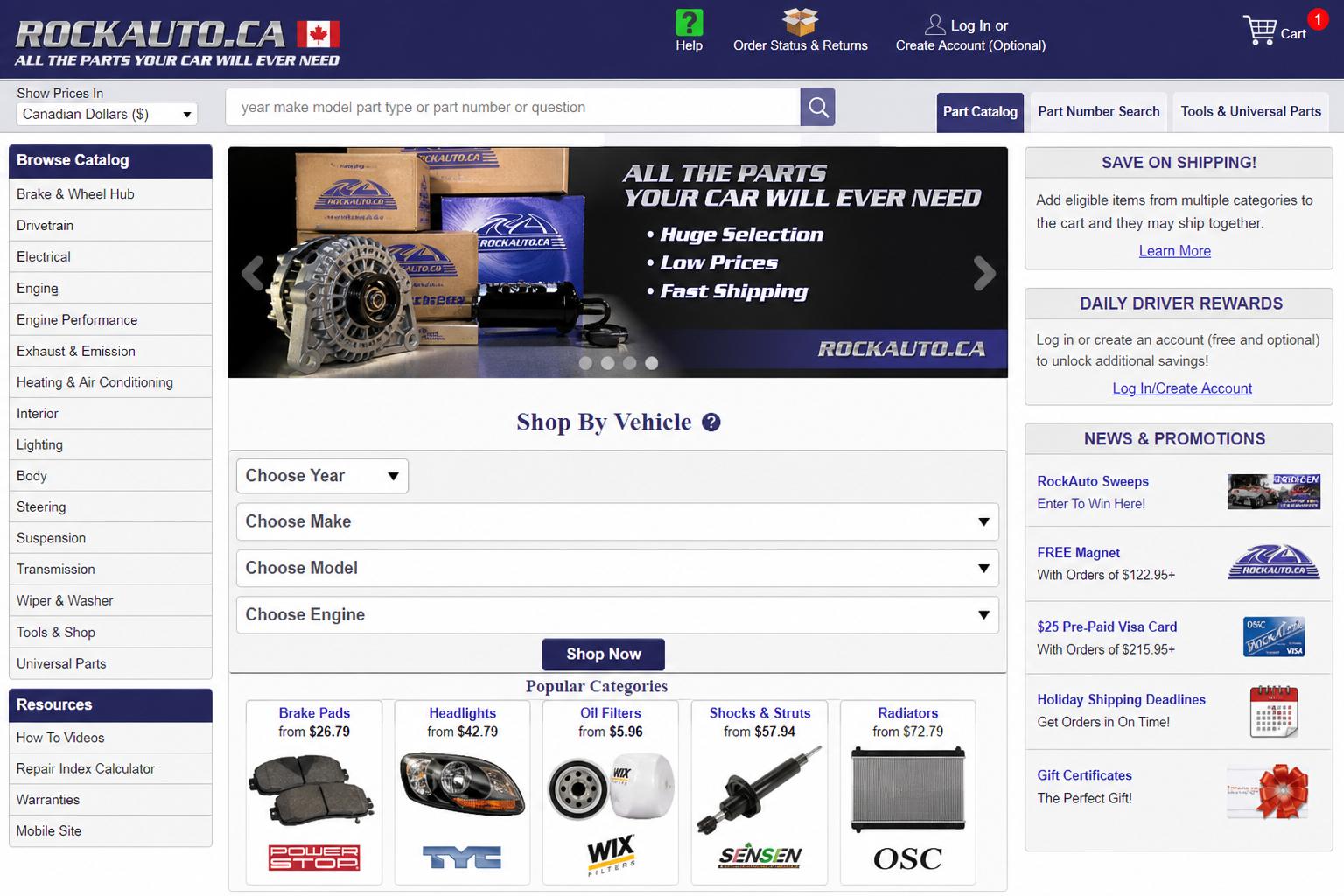
RockAuto is a US-based online auto parts retailer. There’s no separate rockauto.ca website, no Canadian call centre, and no network of local stores. Canadian customers shop on rockauto.com the same as American customers, but with international shipping and import steps added. That’s all “RockAuto Canada” really means—RockAuto purchases shipped to Canadian addresses, with pricing and logistics tailored to a Canadian buyer.
Despite the lack of a Canadian branch, RockAuto is popular here for a few reasons:
- Huge catalog across domestic, European, and Asian brands—everything from OEM-equivalent parts to budget lines.
- Clear categories by year, make, and model, plus detailed fitment notes you won’t always get in a big-box aisle.
- Wholesale-style pricing, frequent “Wholesaler Closeout” discounts, and access to specialty components that are rare in local inventories.
The trade-off? Shipping from the US, navigating Canadian taxes, possible brokerage charges, and more complicated warranties and returns. Those are manageable once you know how to evaluate landed cost (more on that shortly).
Is There a Real “RockAuto Canada” Site or Warehouse?
Short answer: no. There’s no official Canadian version of the website, and there’s no permanent RockAuto Canada warehouse. Your order may ship from one or multiple US warehouses (and sometimes third-party partner locations) directly to your Canadian address. RockAuto does let you view prices in CAD on-site, but the order is still fulfilled from outside Canada unless the listing specifically indicates otherwise.
Why this matters:
- You should assume cross-border shipping for most orders.
- Import-related costs (GST/HST or GST+PST/QST, and possibly brokerage) will apply unless prepaid at checkout.
- Transit times can be excellent for major cities but slower for rural and northern addresses.
Pros and Cons of Ordering from RockAuto to Canada
Let’s be candid about the upside and the potential headaches so you can weigh your decision properly.
Benefits
- Selection: Niche sensors, obscure suspension bits, EV/Hybrid components, and discontinued parts are often easier to find.
- Pricing power: Even after shipping, RockAuto can undercut Canadian retail on many mainstream parts, especially when you avoid multiple-warehouse carts.
- Brand choice: Compare premium brands (e.g., Bosch, ACDelco, Timken, NGK, KYB, Moog) alongside reputable aftermarket alternatives.
- Transparency: Clear notes about fitment details (engine code, axle size, production date) cut down on guesswork.
Drawbacks
- Import friction: Taxes, potential brokerage fees, and occasional customs delays are part of the deal.
- Returns: Shipping parts back across the border can erase savings on low-value items.
- Warranty logistics: You deal with RockAuto online, not a local counter. Shipping costs for warranty returns are usually on you.
- Multiple warehouses: The cart can split into several shipments. Each location adds shipping cost and complicates customs.
- Hazmat and oversize limits: Some items (like aerosols, certain chemicals, or large body panels) may not ship to Canada.
How to Shop RockAuto as a Canadian: Step-by-Step
Follow this workflow and you’ll avoid the usual pitfalls.
1) Confirm Fitment with Canadian Nuances in Mind
Canadian-market vehicles often have subtle differences from US models: daytime running lights (DRL) are mandatory here; trim names may vary; and cold-weather packages (block heaters, alternators with higher output) are more common. Don’t guess. Do this instead:
- Use your VIN for engine and production-date confirmation. Even though RockAuto doesn’t have a VIN decoder entry, your owner’s manual or a VIN lookup site will confirm engine codes and build dates you can match to part notes.
- Study the “info” icons and fitment notes. Details like rotor diameter, axle spline count, or sensor connector shape matter. Many returns happen because of small, avoidable mismatches.
- Match emissions and lighting features. For example, a headlamp or light switch assembly might be different if your car has DRL or auto-light features common in Canada.
2) Keep Your Cart to as Few Warehouses as Possible
RockAuto’s catalog spans many warehouses. If you add parts from Warehouse A, Warehouse B, and Warehouse C, you’ll pay shipping three times and face three import entries. That’s the fastest way to blow your budget.
How to consolidate:
- Sort by “location” or look for parts that ship from the same warehouse as something already in your cart.
- Choose one brand line per system when possible—say, front and rear brakes from the same series—so they ship together.
- Avoid mixing a single small gasket from a different warehouse; buy small consumables locally if it saves a whole extra shipment.
3) Balance Brand, Warranty, and Price
Cheapest isn’t always cheapest once you factor longevity and returns. A $20 no-name sensor that fails in six months can cost you more (in shipping and time) than a $45 part from a recognized brand with better engineering and QC.
Practical approach:
- For critical components (sensors, wheel bearings, timing components), lean toward reputable brands. The Canadian climate is unforgiving.
- For wear items (wipers, air filters, cabin filters), factor in convenience—sometimes it’s smarter to grab them locally.
- Consider coated hardware and corrosion-resistant finishes for anything exposed to road salt.
4) Read the Return Policy and Closeout Warnings
“Wholesaler Closeout” deals can be excellent, but return options may be limited beyond warranty claims. If you’re experimenting or uncertain about fitment, think twice before choosing a closeout part. RockAuto’s standard returns typically require initiating an RMA online within a defined period and paying your own return shipping unless the error is theirs. It’s not complicated—just potentially costly across the border.
5) Use the Shipping and Duties Tool Before You Commit
RockAuto provides shipping options and, in many cases, an estimate to prepay duties and taxes at checkout. Always test different part combinations and shipping methods before you finalize your order. Small changes can shave dollars and days off delivery.
Shipping to Canada: Carriers, Transit Times, and What to Expect
RockAuto typically ships to Canada via major couriers (e.g., FedEx, UPS, DHL) and sometimes via postal routes where available. Your options and prices vary by warehouse location, package size, and the service you choose at checkout.
Transit Time Reality Check
For most urban and suburban addresses in provinces like Ontario, Quebec, BC, and Alberta, cross-border courier shipments often arrive within several business days once dispatched. Rural routes and the territories may add time, especially if weather or customs holds get involved. RockAuto shows estimated delivery windows during checkout—treat them as estimates, not guarantees.
Customs, Duties, Taxes, and Brokerage—How It Works
Bringing goods into Canada involves three buckets of cost beyond the part price and shipping:
- Taxes (GST/HST or GST+PST/QST): Charged on the value of the goods and usually the shipping cost, calculated by your province or territory.
- Duties: May apply depending on the part’s country of origin and trade agreements.
- Brokerage/handling: What the carrier charges to process your import with the Canada Border Services Agency (CBSA), unless you prepay or self-clear.
The details you should know:
- GST/HST applies to most imported goods. In HST provinces (e.g., Ontario, Nova Scotia, New Brunswick, Newfoundland and Labrador, Prince Edward Island) you’ll pay HST at the local rate. In provinces with separate PST/QST, the federal GST (5%) plus provincial tax applies. See the tax table below for a quick overview.
- De minimis thresholds: Under CUSMA/USMCA, for courier shipments from the US or Mexico, customs duty is generally waived below CAD$150, and taxes may be waived below CAD$40. Above those thresholds, taxes (and possibly duties) apply. Postal shipments (through Canada Post) generally retain a much lower threshold, historically around CAD$20 before taxes and duties may be assessed.
- Country of origin matters for duties: Many auto parts are duty-free if they qualify under trade rules (and if documented correctly). If a part is manufactured in a non-preferred country, duty could apply. RockAuto’s checkout may offer a prepaid option that covers duties and taxes to avoid surprises.
- Brokerage: Couriers often charge brokerage on ground services when they advance taxes/duties for you. Some faster service levels may include brokerage. Postal handling fees are typically lower than courier brokerage fees but vary by service and are subject to change by the postal operator.
Prepaid Duties & Taxes at Checkout
RockAuto frequently offers a “prepaid duties and taxes” option for Canadian addresses. This can be worth it if:
- You want a guaranteed landed cost without doorbell surprises.
- You’re in a building where drivers can’t easily collect COD fees.
- You don’t want to deal with self-clearing or brokerage discussions.
The prepaid figure usually includes the applicable GST/HST or GST+PST/QST and any duties or handling needed, then RockAuto (or its logistics partner) handles the paperwork. While not always the cheapest route, it’s predictable—and predictability has value when you’re trying to save time and avoid headaches.
Self-Clearing a Courier Shipment (Advanced Option)
Some Canadians self-clear courier shipments to avoid brokerage fees. The process generally looks like this:
- Receive notice of arrival/tracking update from the courier indicating taxes/duties are due.
- Contact the courier to obtain the required paperwork (commercial invoice, waybill, and any other import details).
- Visit a CBSA office that processes casual imports with your documents (and government-issued ID). Pay the assessed taxes (and any applicable duties) directly to CBSA.
- Provide proof of payment to the courier so the package can be released without their brokerage service.
It’s absolutely doable, but it requires time, coordination, and access to a CBSA office. Policies may vary by courier, and some service levels don’t readily support self-clearing. If you’re counting on this option, confirm feasibility with the carrier in advance.
Taxes by Province and Territory: What You’ll Likely Pay
Here’s a quick-reference table for typical sales tax scenarios on imported goods. Remember, the tax is calculated on the value of the goods and often includes the shipping cost. Regulations can change—always rely on CBSA and provincial/territorial sources for the latest details.
| Province/Territory | Tax Structure | Typical Rate | Notes |
|---|---|---|---|
| Alberta (AB) | GST only | 5% | No provincial sales tax. |
| British Columbia (BC) | GST + PST | 5% + 7% | PST may apply to parts and shipping to BC residents. |
| Manitoba (MB) | GST + RST | 5% + 7% | RST is Manitoba’s provincial tax, similar to PST. |
| Saskatchewan (SK) | GST + PST | 5% + 6% | PST rules apply to most auto parts. |
| Ontario (ON) | HST | 13% | Harmonized sales tax collected as a single rate. |
| Quebec (QC) | GST + QST | 5% + 9.975% | QST administered by Revenu Québec. Calculations are standardized; modern rules no longer apply “tax on tax.” |
| New Brunswick (NB) | HST | 15% | Harmonized rate. |
| Nova Scotia (NS) | HST | 15% | Harmonized rate. |
| Newfoundland and Labrador (NL) | HST | 15% | Harmonized rate. |
| Prince Edward Island (PE) | HST | 15% | Harmonized rate. |
| Yukon (YT) | GST only | 5% | No territorial sales tax. |
| Northwest Territories (NT) | GST only | 5% | No territorial sales tax. |
| Nunavut (NU) | GST only | 5% | No territorial sales tax. |
Calculating Landed Cost for RockAuto Canada Orders
Landed cost is what you actually pay in the end. Use a simple formula:
(Part prices + Shipping) + Taxes + (Duties if any) + (Brokerage/handling if any) = Landed cost
How to make this practical:
- Build your cart and experiment with consolidating warehouses—watch shipping drop when you stick to one location.
- Use RockAuto’s checkout preview to compare shipping methods. Note whether an option offers prepaid duties and taxes.
- Estimate taxes using your provincial rate based on the subtotal + shipping. If you prepay duties/taxes, RockAuto will calculate that for you.
- Brokerage varies by carrier and service. If you opt not to prepay, assume a brokerage or handling fee could be added on delivery for many ground courier services.
Tip: Keep an eye on currency. RockAuto can show CAD pricing, but your card issuer may still treat the transaction as foreign if it’s processed outside Canada. Some cards add a foreign transaction fee. Check with your bank so your math is honest.
Returns, Warranties, and Core Charges for Canadian Buyers
These are the big friction points. It’s not that RockAuto is difficult; cross-border logistics make small-dollar returns and warranty claims less attractive.
Returns
- Initiate returns through RockAuto’s website; you’ll get instructions and an RMA.
- Unless the error is theirs, return shipping is on you. From most Canadian addresses to a US return location, that cost can be meaningful.
- Don’t open boxes or install parts until you’re sure about fitment. Returns typically require parts to be in resalable condition.
- “Wholesaler Closeout” parts often have restricted returns. Double-check the listing language before buying.
Warranty Claims
- Warranty starts with RockAuto; you don’t take the part to a Canadian retailer for swap.
- You’ll likely need to ship the defective part back to the designated address for inspection or replacement authorization.
- Shipping across the border for warranty can wipe out savings on low-cost items. On higher-value components (e.g., wheel bearings, struts), it may still be worth it.
Core Returns
Some parts (alternators, calipers, power steering pumps) carry a refundable core charge if you return your old unit. Returning a core to the US from Canada can be costly and sometimes risky (fluids must be drained; hazmat rules can apply). Before you buy a core-bearing part from RockAuto to a Canadian address, ask yourself:
- Is the core refund larger than the estimated shipping back to the US?
- Does a local parts store offer a similar net price once you factor a simple in-person core return?
Common Mistakes Canadians Make—and How to Avoid Them
- Mixing warehouses for tiny savings: Paying triple shipping to save $8 on a filter is a losing game.
- Ignoring taxes and brokerage: A “$120 order” that lands at $170 feels like a bad surprise. Price the whole picture.
- Guessing on fitment: Canadian trim and DRL differences can bite. Verify engine code, axle size, rotor diameter, and build date.
- Buying hazmat or oversize items: Some items won’t ship to Canada or are uneconomical to ship. Check shipping eligibility before you plan your repair around them.
- Relying on warranty for cheap parts: A $15 sensor with a two-hour cross-border return saga is not a win.
When RockAuto Beats Canadian Retail—and When It Doesn’t
There’s no single answer. Here’s how to judge realistically.
RockAuto is often best for:
- Mid-to-high value components: Wheel bearings, complete strut assemblies, quality brake kits, electronic sensors from premium brands.
- Rare and specialty parts: Older vehicles, European cars, or trim-specific components local suppliers don’t stock.
- Full system refreshes from one warehouse: For example, shocks, mounts, and bump stops for all four corners shipped from a single location.
Local Canadian options may win for:
- Low-cost wear items: Wipers, simple filters, bulbs—especially when local shops run promotions.
- Items with core charges: In-person core returns simplify life.
- Emergency repairs: Waiting on customs over a long weekend is no fun.
- Warranty-sensitive purchases: If you want instant in-person exchanges, a local counter is hard to beat.
Canadian Climate Realities: Choosing Parts that Last
Our roads, weather, and salt change what “good value” means. Consider these upgrades and features when filling your RockAuto cart.
Brakes for Rust Belt Conditions
- Coated rotors and stainless hardware kits resist corrosion and save you grief during the next brake job.
- Ceramic pads can reduce dust and corrosion staining, though performance in severe cold varies by formulation—check brand notes and reviews.
- Rubber boots and seals: When choosing calipers and slide pin kits, prioritize quality elastomers for longevity in freeze-thaw cycles.
Suspension and Steering
- Premium tie-rod ends and ball joints often use better boots and grease fittings. That matters once winter slush gets in.
- Complete control arms with pre-pressed bushings can be more economical than pressing bushings yourself, especially without shop tools.
Electrical and Sensors
- Choose reputable brands for ABS, crankshaft, and cam sensors. Tolerances matter in cold starts and with road salt intrusion.
- Check connector style and pigtail notes; Canadian models occasionally differ in harness details versus US equivalents.
Fluids and Hazmat
Many aerosols, flammable liquids, and chemicals face shipping restrictions. If you’re refilling coolant, brake cleaner, or undercoating spray, buying those locally is often faster, safer, and cheaper than cross-border shipping.
Payment, Currency, and Exchange Considerations
RockAuto allows you to display prices in CAD. Whether your payment is processed in Canada (and fee-free) depends on the payment processor and your card issuer. Some Canadian credit cards add a foreign transaction fee even when the currency is CAD if the merchant is outside Canada. To stay in control:
- Check with your bank or card issuer about foreign transaction fees for cross-border merchants.
- Consider payment options like PayPal if you prefer their exchange handling and dispute process. Review their currency conversion rates and fees first.
- Use a no-foreign-transaction-fee card if you have one.
Business Buyers and Shops in Canada
If you’re a Canadian business registered for GST/HST (or QST in Quebec), parts imported for commercial use can be eligible for input tax credits (ITCs) or input tax refunds, subject to CRA/Revenu Québec rules. Keep clean records:
- Retain the commercial invoice from RockAuto and the import documents showing GST/HST or QST paid at the border or via prepaid options.
- Ensure the business name on the import documentation matches your GST/HST registration details.
- Consult your accountant regarding documentation standards for ITC claims and provincial rules.
Legal and Compliance Notes for Canadian Modifications
Transport Canada and provincial regulations govern what’s road-legal. Before importing lighting, suspension lifts, or emissions components:
- Lighting: Ensure aftermarket headlamps, bulbs, and LED conversions comply with Canadian Motor Vehicle Safety Standards (CMVSS). Non-compliant lights can fail inspection or earn a ticket.
- Emissions: Tampering with emissions controls can be illegal and may cause your vehicle to fail provincial inspections where applicable.
- Tint and accessories: Provincial rules vary. If you’re importing tint films, plates, or visibility-affecting items, confirm local legality first.
Real-World Scenario Walkthroughs (Illustrative)
These are examples to help you think through total cost. They’re not promises of exact pricing—just realistic planning tools.
Scenario 1: Brake Refresh in Ontario
You’re buying front rotors and pads for a 2016 Civic in ON. You pick a coated rotor and ceramic pad set from the same brand, both shipping from a single warehouse. Shipping is reasonable, and RockAuto offers a prepaid duties and taxes option.
- Cart subtotal (CAD): Moderately priced, not the cheapest line.
- Shipping: One box from one warehouse.
- Taxes: HST at 13%, prepaid at checkout.
- Brokerage: Included in prepaid option, so no delivery surprises.
Result: You pay a transparent landed cost up front. Compared to a local parts counter, you save, and you get the coated rotors you specifically wanted without calling around three stores.
Scenario 2: Wheel Bearing in Quebec with Mixed Warehouses
You need a rear wheel hub assembly and add a single ABS pigtail from another warehouse to “save” a few dollars. Checkout shows two shipments.
- Hub ships from Warehouse A, pigtail from Warehouse B.
- Each shipment has separate shipping and import processing.
- GST + QST applies on each shipment’s value and shipping cost.
Result: Your total lands higher than expected. Had you chosen a compatible pigtail from the same warehouse—or waited to buy the pigtail locally—you’d likely have saved money and time.
Scenario 3: Alternator with a Core in BC
A rebuilt alternator carries a core charge. The part price looks great online until you factor the cost and hassle of shipping your old alternator back to the US.
- Core refund vs. outbound shipping and paperwork.
- Local RMA is easier if a nearby shop has a similar net price after core exchange in person.
Result: If the RockAuto savings are large enough, it can still make sense. But for many buyers, a local counter wins once cores enter the picture.
Border Pickup: Using a US Parcel Address and Self-Importing
Some Canadians living near the border use US parcel receiving services, then declare the goods when crossing back into Canada. If you consider this route:
- Declare honestly at CBSA and be ready to pay taxes (and duties if applicable). Personal exemption rules depend on time spent outside Canada.
- Factor in fuel, time, and any receiving service fees. That “cheap” pickup can turn expensive quickly.
- Warranty and returns still involve shipping back to the US or another border trip.
For most people, direct shipping to your Canadian address with prepaid duties and taxes is simpler and usually competitive once you value your time.
Checklist Before You Click “Place Order”
- Part fitment verified by engine code, build date, and dimensions (rotor size, connector type, etc.).
- All items from as few warehouses as possible—preferably one.
- Shipping method chosen after comparing speed, cost, and whether it includes/prepays taxes and duties.
- Return and warranty terms reviewed—especially for closeouts and electrical parts.
- Core charges considered: is returning the core across the border practical?
- Payment method checked for foreign transaction fees.
- Total landed cost calculated, including tax and any brokerage.
Alternatives to RockAuto for Canadian Shoppers
RockAuto isn’t your only option, and sometimes the smartest move is buying locally—even if the sticker price is higher—because of warranty, cores, or timing.
- Dealer online portals: For true OEM parts where fitment must be exact, many Canadian dealers now sell online. Prices can be better than at the counter, and shipping is domestic.
- Canadian retail chains: NAPA, CARQUEST, PartSource, Lordco (BC), and others offer decent brand selection and quick pick-up. Price-matching policies typically exclude US-only retailers, but they may match Canadian competitors.
- Amazon.ca and Canadian marketplaces: Be cautious with third-party sellers and warranty support. Still, for common lines and tools, they can be convenient.
- Specialty importers: European and performance parts often have Canadian distributors who understand local compliance and offer better support.
Troubleshooting and Practical Tips That Save Canadians Money
- Build two carts: a “budget” cart and a “premium” cart that consolidates warehouses better. Sometimes the premium cart is cheaper after shipping.
- Check the fine print: Some listings include detailed photos of connectors and measurements—use them.
- Avoid penny-wise shipping traps: Adding one $6 clip from a distant warehouse can cost $20+ in extra shipping and fees.
- Think seasons: Order suspension and brake parts ahead of winter. Customs delays seem longer when you need the car running tomorrow.
- Save packaging: If a warranty return happens, original boxes make the process smoother and reduce damage risk.
RockAuto Canada Myths—Clearing the Air
- Myth: “RockAuto has a Canadian branch.” Reality: It’s a US-based operation shipping to Canada.
- Myth: “No taxes on small orders.” Reality: Rules depend on courier vs postal and de minimis thresholds. Don’t bank on getting waved through.
- Myth: “Brokerage is always ridiculous.” Reality: It varies. Prepaying duties and taxes can neutralize surprises. Some service levels include brokerage.
- Myth: “Returns are impossible.” Reality: They’re straightforward but can be uneconomical for low-cost parts because of cross-border shipping.
The Bottom Line: Is RockAuto Worth It in Canada?
For many Canadians, yes—especially for mid-to-high value parts, specialty components, and full-system refreshes that ship from a single warehouse. The key is disciplined cart-building and honest landed-cost math. If you prioritize convenience, local returns, or need something today, a Canadian retailer might edge it out. But when you cherry-pick the right items and shipping options, RockAuto can deliver serious value to Canadian driveways and shop bays.
FAQ: RockAuto Canada Questions Answered
Does RockAuto have a Canadian website or warehouse?
No. You’ll shop on rockauto.com. Orders ship from US-based warehouses (and partners) to Canadian addresses. There isn’t a separate rockauto.ca site.
Can RockAuto ship to all Canadian provinces and territories?
Generally, yes. Major couriers and postal partners serve most locations, but remote and northern addresses may face higher costs and longer transit times. Some items (hazmat or oversize) might be restricted.
How long does shipping from RockAuto to Canada take?
It varies by carrier, service level, and destination. Many urban addresses see delivery within several business days after dispatch. Rural routes and the territories can take longer, especially if customs holds occur.
Will I pay taxes and duties on RockAuto orders to Canada?
Expect to pay GST/HST or GST+PST/QST based on your province or territory. Duties may apply depending on the part’s country of origin and value. Under CUSMA/USMCA, for courier shipments, duty is typically waived below CAD$150 and taxes may be waived below CAD$40; postal shipments often have lower thresholds. Rules and enforcement can vary—use RockAuto’s prepaid option for predictability.
What about brokerage fees?
Couriers often charge brokerage for processing imports on ground services. Faster services may include brokerage. If you prepay duties and taxes at checkout, brokerage is usually built in so you won’t get a COD surprise. Postal routes typically use lower handling fees, but specifics vary.
Can I prepay duties and taxes with RockAuto?
Often yes. When available, choosing prepaid duties and taxes gives you a guaranteed landed cost and avoids paying fees at the door. This is a popular choice for Canadian customers.
Is it cheaper to ship to a US parcel depot and bring parts across myself?
Sometimes, but factor in your time, fuel, parcel receiving fees, and the need to declare and pay taxes (and duties if applicable) at the border. For many buyers, direct shipping with prepaid duties and taxes is simpler and competitive.
What if my part doesn’t fit?
Start a return through RockAuto’s website. You’ll get an RMA and instructions. If the error isn’t on RockAuto, you pay return shipping, which can be expensive cross-border. That’s why careful fitment checks are crucial before ordering.
How do warranties work for Canadian customers?
You’ll work directly with RockAuto online. Typically you’ll ship the defective part back for evaluation or replacement. Shipping costs are usually your responsibility. For low-cost parts, it may not be worth claiming; for pricier items, it often is.
Are “Wholesaler Closeout” parts safe to buy?
Closeouts can be great values, but returns are often restricted beyond warranty claims. Only choose closeout parts when you’re confident in fitment and the brand’s quality.
Can I use a P.O. Box in Canada?
Couriers generally require a physical address. Postal-enabled shipping methods may deliver to P.O. Boxes, but availability depends on the service shown at checkout.
Does RockAuto charge in CAD?
You can view prices in CAD. Whether your card treats it as a foreign transaction depends on the payment processor and your issuer’s policies. Some cards add a foreign transaction fee even in CAD if processed outside Canada. Confirm with your bank.
What about environmental fees and core charges?
Core charges are refundable if you return the old part, but returning cores across the border can be costly. Environmental or eco fees are governed by provincial rules; cross-border sellers may not collect them the same way as Canadian retailers. Consider total cost and practicality.
Can I avoid brokerage by self-clearing?
Often yes, but it takes effort. You’ll need to coordinate with the courier, obtain documents, visit a CBSA office, pay taxes/duties directly, and provide proof to the courier. It’s feasible for some shipments and buyers, but not everyone finds it worth the time.
Are aftermarket lights and LED conversions from RockAuto legal in Canada?
Only if they comply with CMVSS and provincial regulations. Many aftermarket lighting products are not legal for on-road use here. Check compliance before buying.
What’s the smartest way to save with RockAuto in Canada?
Consolidate your cart to one warehouse, choose reputable brands for critical parts, use prepaid duties/taxes for predictable landed cost, and skip cross-border returns on cheap items by getting wear-and-tear consumables locally. That playbook consistently keeps costs down without surprises.